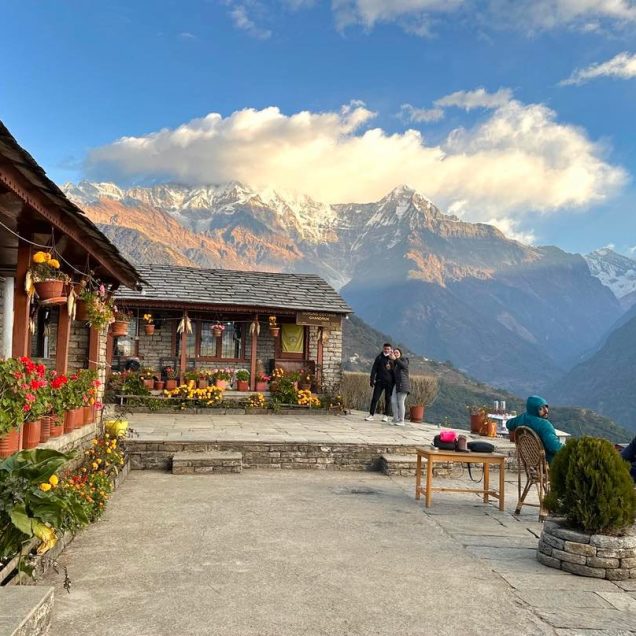
Ghandruk is the most iconic and frequently visited traditional village in the Annapurna Conservation Area, offering an unparalleled blend of cultural richness and striking natural beauty. Situated at an incredibly comfortable altitude of roughly 1,940 meters, it acts as the perfect destination for families, casual hikers, and travelers who are short on time but still want to experience the grandeur of the Himalayas. The village is built directly into the steep hillside, featuring hundreds of traditional houses crafted from local stone and timber, beautifully topped with slate roofs. The absence of modern roads within the core of the village preserves a peaceful, timeless atmosphere, where transportation is still handled by mule trains and local porters navigating the steep, winding stone staircases.
The primary draw of Ghandruk is its jaw-dropping geographical positioning. The village faces directly north toward the Annapurna Massif. Visitors do not need to hike for days to see the mountains; the towering peaks of Annapurna South (7,219m), Hiunchuli (6,441m), and Machhapuchhre (6,993m) command the skyline directly above the village rooftops. The sunrises and sunsets here are legendary, casting golden and pink hues across the glaciers and creating some of the most sought-after photography opportunities in the entire country.
However, a visit to Ghandruk is equally about engaging with the local community. It is the ancestral home of the Gurung people, famous for their service as elite Gurkha soldiers in the British and Indian armies. The village is remarkably clean and well-organized, supported by strong local community committees. Travelers can spend their days visiting the Old Gurung Museum to learn about traditional agricultural tools and martial history, renting traditional velvet Gurung outfits for vibrant photographs, and observing local artisans hand-weaving intricate wool carpets and baskets. With its highly developed network of premium teahouses offering excellent food and warm beds, Ghandruk stands as a testament to the balance between modern tourism and the strict preservation of ancient mountain heritage.
Sights
Map
Info
The Architectural and Cultural Heritage The defining characteristic of Ghandruk is its perfectly preserved architecture. Unlike many modernizing villages in the lower foothills that have adopted concrete and tin, Ghandruk fiercely maintains its traditional aesthetic. The homes are built using dry-stone masonry techniques that have survived centuries of harsh weather and earthquakes. Intricately carved wooden windows and doors are a hallmark of the older homes, showcasing the exceptional craftsmanship of the Newari artisans who historically traveled here for trade. The village is structured around communal courtyards, where locals gather to dry golden ears of corn, sort locally harvested millet, and weave textiles on wooden handlooms. Walking through the village feels like navigating a massive, living open-air museum.
The Gurung Identity and the Gurkha Legacy To understand Ghandruk is to understand the Gurung people. This ethnic group, originally of Tibeto-Burman descent, has inhabited these specific hills for centuries, developing a distinct language, animistic/Buddhist religious practices, and a vibrant agrarian culture. However, they are most globally recognized for their military prowess. Since the early 19th century, young men from Ghandruk and the surrounding valleys have been recruited into the Gurkha regiments of the British Army. Known for their motto, “Better to die than be a coward,” the financial remittances and pensions from these retired soldiers have significantly funded the impressive infrastructure, schools, and cleanliness of the village today. The local Old Gurung Museum offers a fascinating, intimate look into this dual identity of peaceful mountain farmers and fierce global warriors.
Trekking Routes and Accessibility Ghandruk’s popularity is heavily tied to its excellent accessibility. The journey typically starts from Pokhara. In recent years, the construction of rural dirt roads has dramatically shortened the walking time required to reach the village. Travelers can now take a jeep all the way up to the settlement of Kimche, leaving only a short, beautiful 1 to 2-hour uphill hike on stone steps to reach the main village of Ghandruk.
For those looking for a longer trekking experience, Ghandruk is a critical junction. It serves as a primary stop on the descent from the famous Poon Hill sunrise trek, and it acts as the traditional starting gateway for the massive expedition up into the Annapurna Sanctuary (ABC). The trails surrounding the village cut through beautiful terraced farms of wheat and mustard, and dense forests of oak and rhododendron that are alive with the sounds of hidden waterfalls and exotic birdlife.
Flora, Fauna, and Conservation Ghandruk sits within the borders of the Annapurna Conservation Area Project (ACAP), which is Nepal’s largest protected area. The village serves as a shining example of ACAP’s mission to balance environmental conservation with sustainable community development. The surrounding forests are rich in biodiversity. Bird watchers flock to this area to spot exotic species, including the spectacular Danphe (the Himalayan Monal, Nepal’s national bird). The dense forests above the village are also home to elusive wildlife, such as the Himalayan tahr, barking deer, and occasionally, leopards.
Travel Logistics and Best Time to Visit Because Ghandruk is located at a relatively low altitude (1,940m), altitude sickness is not a concern, making it the perfect destination for young children and older travelers. The local teahouses are among the best-equipped in the Himalayas, offering private rooms, attached western-style bathrooms, hot showers powered by solar energy, and dining rooms featuring surprisingly fast Wi-Fi and excellent coffee. The best time to visit is during the post-monsoon autumn months (September to November) when the skies are brilliantly clear, offering the sharpest mountain views. The spring (March to May) is also spectacular, as the weather warms up and the surrounding hills explode into color with blooming rhododendrons. The summer monsoon season should generally be avoided, as the trails become slippery and leeches are highly prevalent.